← Presentation home · Part 12 of 13
More features (the parts we did not demo)
Deep dive
More features (the parts we did not demo)
TL;DR
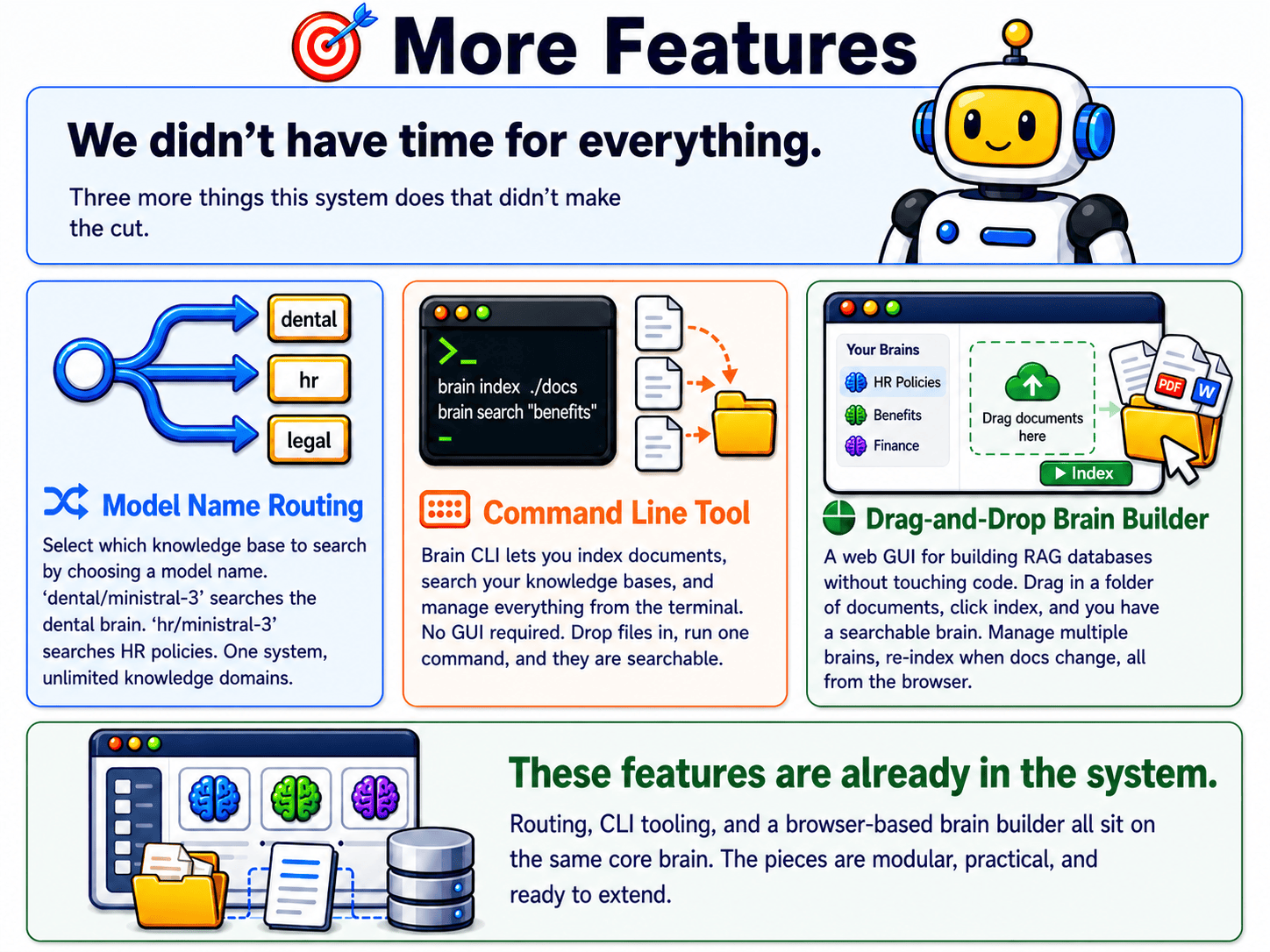
Three more capabilities already built into the system: model name routing (covered briefly in slide 10, first-class feature, not a hack), a command-line tool (ragproxy-ingest, makes the whole system scriptable), and a drag-and-drop brain builder (a web GUI for non-technical users). All three run on the same Brain.pm core. That is what "modular" actually means.
What this is
There is more to the system than fits in one talk. This deep-dive covers the three capabilities we did not get to demo, each one a different angle on the same engine.
The purpose is to signal depth, the system is a real tool, not a demo toy, without going down three more rabbit holes in the live session.
Feature 1, Model name routing (revisited briefly)
Already introduced in slide 10's deep-dive. Quick recap, because it bears repeating:
Select which knowledge base to search by choosing a model name. dental/ministral-3 searches the dental brain. hr/ministral-3 searches HR policies. One system, unlimited knowledge domains, and the only control surface is the model dropdown the user already knows.
The deeper point: the proxy can register any number of brains through BRAIN_<NAME> environment variables. The dental brain, a Perl brain, an HR brain, each is just a directory with a SQLite file and a vector matrix. Adding a domain is adding a folder, not writing code.
That last sentence is the architectural difference between "extending a feature" and "extending infrastructure." Feature extension is code work. Infrastructure extension is data work.
Feature 2, Command line tool
ragproxy-ingest is the command-line interface for managing brains. No GUI required, no special tooling, just a Perl script you run from your terminal.
# Make a new brain
ragproxy-ingest create hr-policies

# Index documents into it
ragproxy-ingest add hr-policies ./docs/

# Test the search
ragproxy-ingest search hr-policies "leave policy"

# See all brains
ragproxy-ingest list

# Re-index after documents change
ragproxy-ingest rebuild hr-policies
Why this matters: it makes the whole system scriptable.
- Index documents from a cron job (
0 3 * * * ragproxy-ingest rebuild policies) - Rebuild a brain as part of a deploy script
- Test retrieval quality from the terminal
- Evaluate against gold-standard questions in CI
This is the exact thing built-in RAG (slide 08) cannot do, because built-in RAG has no reachable surface. The CLI is what "RAG as infrastructure" looks like in practice. You can drive the system from any tool that can invoke a subprocess, Bash, Python, Perl, Make, GitHub Actions, anything.
A workflow this enables
A small but powerful pattern: drift detection.
Every night, a cron job re-indexes the policy documents. If the chunk count or token count changes significantly compared to yesterday, it sends an alert. That tells you somebody edited a document and the system has noticed.
You cannot build that from inside a chat app's hidden RAG. You can build it in twenty lines of shell on top of ragproxy-ingest.
Feature 3, Drag-and-drop brain builder
A web GUI for building knowledge bases without touching code. Drag in a folder of documents, click index, and you have a searchable brain. Manage multiple brains, re-index when documents change, all from the browser.
This is the on-ramp for non-technical users. Not everyone wants to live in a terminal. The CLI is for the scripters. The brain builder is for everyone else. Same core engine underneath, two front doors.
What you can do from the brain builder:
- Create a new brain (just a name)
- Drop in files (drag-and-drop or click-to-upload)
- Watch indexing progress
- See chunk counts per document
- Trigger re-indexing
- Delete documents or whole brains
- Run a test search to verify retrieval quality
For an organization with non-developers who need to maintain their own knowledge bases, this is the difference between "a system the IT team has to babysit" and "a system the actual subject-matter experts can run."
The closing point: modular, ready to extend
The slide ends on the architectural lesson. Routing, the CLI, and the brain builder are not three separate products. They all sit on the same core, Brain.pm. Each one is just a different way to reach the same engine.
That is what "modular" actually means here:
> The retrieval engine has no idea whether it was called by the proxy, the command line, or the web builder. It just retrieves.
New front ends can be added without touching the core. The core can be improved without touching the front ends. That separation is not aspirational, it is how the code is actually shaped.
Examples of front ends you could add tomorrow:
- A Slack bot that answers from your knowledge base when @-mentioned
- A GitHub action that re-indexes documentation on every push
- An API endpoint that other internal apps can hit
- A VS Code extension that lets developers ask questions about codebase docs
None of those would require changing Brain.pm. They would each be a thin wrapper.
Say this plainly: this is why moving RAG out of the app mattered. Once retrieval is its own piece, you can wrap it in as many interfaces as you need. A feature locked in an app gets one interface, forever.
The pattern, in general
This is a recurring move in good system design:
- Identify the core capability (retrieval).
- Build it as a self-contained piece (Brain.pm).
- Wrap it in whatever interfaces the use cases need (proxy, CLI, GUI).
- Add new interfaces as needed without touching the core.
The cost of getting this right early is small, extra discipline about boundaries. The cost of getting it wrong is enormous, the core capability is entangled with one interface and you spend years trying to extract it.
FAQ
Are these actually built, or roadmap? Built and in the system. The slide says so deliberately. This is not a wishlist, it is a tour of what is already there.
Can I add my own front end? Yes, that is the design. Anything that can call Brain.pm, or call the proxy, gets retrieval. A Slack bot, a cron job, another web app. The core does not care who is calling.
Which one should I start with? If you script, the CLI. If you do not, the brain builder. Either way you end up with the same brains, usable by the proxy through model-name routing.
What about an API for direct queries (not through the chat app)? The proxy already exposes that. Hit /v1/chat/completions (OpenAI style) or /api/chat (Ollama style) directly with curl or any HTTP client. The retrieval happens regardless of who calls.
Could the brain builder be a SaaS one day? It could, but the design assumption is local. Multi-tenant brain builders introduce auth, isolation, and resource management that the current design intentionally does not have. That is a different product.
If you only remember one thing
Three front ends, one engine. That separation is what "RAG as infrastructure" gets you that "RAG as a feature" can never give.